Brown Patches Get Attention Fast
For professional landscapers, that attention usually starts with a phone call: “Something is wrong with the lawn.” From there, the pressure is on to explain what happened, what needs to be done, and how quickly the turf can recover.
White grubs are often part of that conversation, but they should not be the automatic conclusion.
A struggling patch of turf can be caused by drought stress, disease pressure, heat, compaction, poor soil conditions, irrigation inconsistency, or insect feeding. Treating every damaged area as a grub problem can lead to unnecessary applications, wasted material, unhappy customers, and a weaker long-term maintenance strategy.
The better question is not, “What do we apply?”
The better question is, “Have we confirmed what is causing the damage?”
What Grub Damage Actually Looks Like
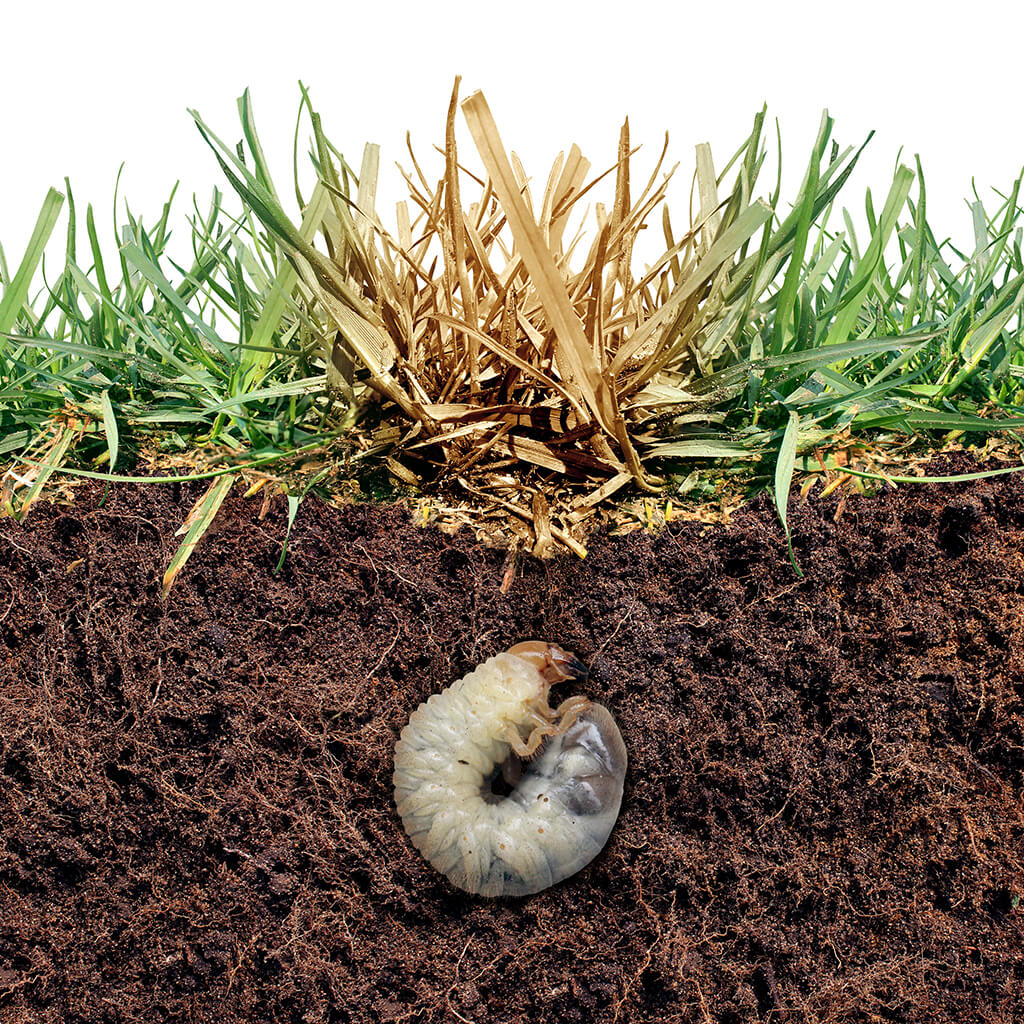
White grubs feed below the surface, damaging the root system of turfgrass. That is why the first visible symptom can look like general decline: irregular yellowing, browning, thinning, or turf that appears dry even after watering.
That last point matters.
When turf is simply dry, timely irrigation can often improve color and help the plant rebound. When white grubs are feeding on the roots, the issue is different. The plant may not have enough root structure left to take up water and nutrients effectively.
One of the clearest field checks is physical. Damaged turf may lift easily, almost like loose carpet, because the roots holding it in place have been consumed. At that point, a visual inspection of the soil and root zone can confirm whether white grubs are present.
Look for soft, plump, C-shaped bodies that are whitish or cream-colored, usually with a caramel or brownish head. Upon closer inspection, white grubs have three pairs of legs near the head.
Finding one or two does not always justify treatment. Grubs can be present in turf without causing meaningful damage. The decision should be based on visible symptoms, grub counts, turf value, site history, customer expectations, and the overall condition of the lawn.
Don’t Treat the Whole Property Because One Area Has a Problem
This is where professional judgment matters.
A grub infestation is often localized. It may affect a specific area of the property rather than the entire lawn. Full-property treatment without confirmation can create unnecessary cost and increase pesticide use without improving the outcome.
For commercial properties, HOAs, athletic fields, and managed residential accounts, that distinction is important. The customer may see “brown grass.” The professional sees a site condition that needs to be diagnosed before a recommendation is made.
That approach protects the turf, the budget, and the credibility of the maintenance program.
Fertility Still Has a Role, But It Is Not Insect Control
Screamin’ Green® does not kill grubs.
That is not its job.
Fertilizer and insect control serve different purposes. When white grubs are active and causing damage, an appropriate insecticide may be needed to stop further root feeding. Screamin’ Green® supports the nutritional side of the program by helping maintain healthy turf in areas not affected by grub feeding and supporting recovery once the pest pressure has been addressed.
That distinction is important for setting expectations with clients.
A strong fertility program helps turf maintain color, density, and overall vigor through the season. It can also help surrounding turf fill in more quickly after damage is controlled. But if roots are actively being consumed, fertility alone will not solve the problem.
The right sequence is simple:
- Confirm the issue.
- Treat the pest only where treatment is justified.
- Continue supporting the turf nutritionally.
- Repair or overseed damaged areas as needed.
That is a more disciplined approach than reacting to every brown patch with a blanket application.
When Chemical Control Makes Sense
Chemical control should be considered case by case, especially when grub populations are high, damage is active, or the site has a documented history of grub pressure.
Two active ingredients commonly used in grub management are:
Chlorantraniliprole
This is typically used as a preventive option. It is most effective when applied before serious damage occurs, targeting young grubs early in their life cycle. It can be a good fit for high-value turf or properties with a known history of grub problems.
Trichlorfon
This is typically used as a curative or rescue treatment when grubs are already present and actively feeding. It is short-lived compared with preventive materials, so timing and proper application are important.
Imidacloprid is another common preventive active ingredient used in grub programs, particularly when applied before damage appears. As with any pesticide, applicators should verify the label, timing, target pest, local regulations, and site conditions before making a recommendation.
Regardless of the product selected, grub-control materials need to reach the root zone where the insects are feeding. That means watering-in is not a minor detail. It is part of the application strategy.
A Better Conversation With the Customer
Grub calls are not just technical. They are communication moments.
Instead of saying, “You have grubs, so we need to treat,” a stronger professional response sounds more like this:
“We’re seeing turf decline in a few specific areas, but before we recommend treatment, we want to confirm whether white grubs are actually the cause. If they are present at damaging levels, we can treat the affected areas. The rest of the lawn should stay on its fertility schedule so it remains healthy and has the best chance to recover once the pest pressure is addressed.”
That kind of answer builds trust.
It shows the customer that you are not guessing. You are diagnosing. You are not overselling. You are managing the lawn based on what is actually happening.
The Clarus® Approach: Diagnose First. Feed With Purpose.
Most turf problems do not need more noise. They need a clearer process.
White grubs can cause real damage, but they should be confirmed before they are treated. A fertility program should not be positioned as pest control, and a chemical application should not be used as a substitute for sound agronomic decision-making.
For professional landscapers, the best program is not the most aggressive one. It is the one that keeps turf healthy, identifies problems accurately, treats only when needed, and supports recovery after stress.
Screamin’ Green® fits into that system by doing what strong fertility should do: support the health, color, density, and recovery potential of the turf.
Grubs may create the damage.
Good diagnosis protects the program.